
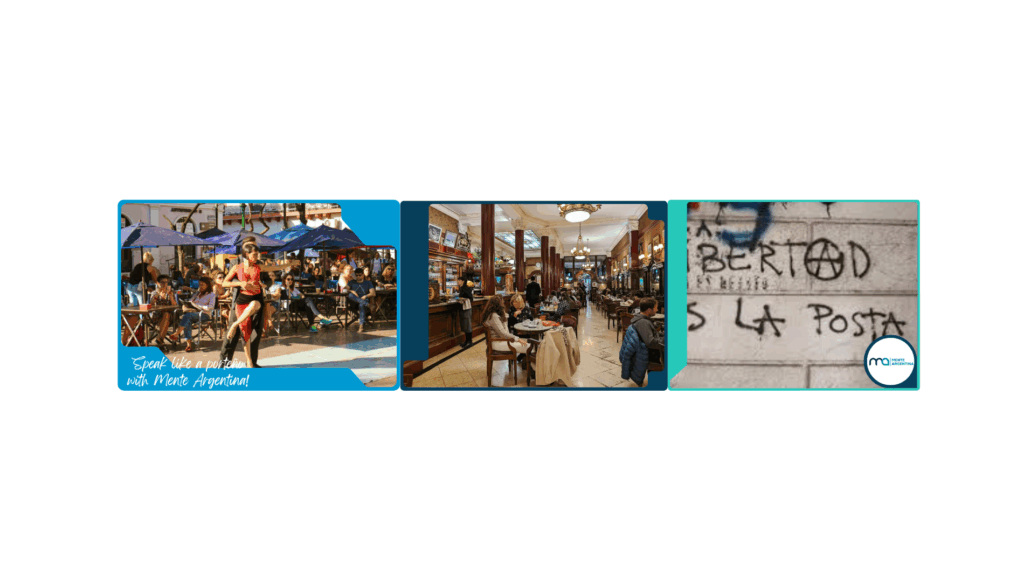
You can study Spanish for years and still arrive in Buenos Aires wondering whether everyone is speaking the same language you learned in class.
Porteño Spanish has its own rhythm, pronunciation, vocabulary and sense of humor. People use vos instead of tú, the letters ll and y often sound closer to “sh” or “zh,” and everyday conversation is packed with expressions that rarely appear in a standard textbook.
Then there is lunfardo: the historic vocabulary of the Río de la Plata that grew alongside immigration, tango and urban life and became one of the most recognizable features of Buenos Aires culture.
This guide brings the two together. You will learn what lunfardo actually is, how Buenos Aires Spanish differs from other varieties of Spanish and more than 50 Argentine words and expressions you are likely to hear while living, studying or traveling in the city.
One important rule before you start: slang depends heavily on tone, age, context and relationship. Some expressions below are completely harmless; others can be affectionate between close friends and offensive with a stranger. We mark those differences so you can understand far more than you immediately try to say.
What Is Lunfardo?
Lunfardo is a vocabulary tradition associated with Buenos Aires and the wider Río de la Plata. It developed during the intense social and linguistic mixing of the late nineteenth and early twentieth centuries, when large waves of immigrants arrived in Buenos Aires and Montevideo.
Italian languages and dialects had an especially strong influence, but lunfardo also absorbed words and expressions from Spanish varieties, Indigenous languages, Portuguese, French and other sources. It became deeply connected with popular urban culture and later with tango lyrics.
Today, many lunfardo words are no longer secret or marginal at all. They are simply part of normal Argentine speech.
But there is an important distinction: not every Argentine slang word is technically lunfardo. Modern porteño speech includes old lunfardo, newer youth slang, abbreviations, internet language and ordinary Argentine colloquialisms. For a visitor, separating those categories is less important than learning what a word means, how strong it is and when people actually use it.
Why Does Buenos Aires Spanish Sound Different?
Voseo: vos instead of tú
In Buenos Aires and much of Argentina, people normally use vos rather than tú for informal singular “you.”
That also changes common verb forms:
- vos tenés instead of tú tienes
- vos querés instead of tú quieres
- vos podés instead of tú puedes
- vení instead of ven
- decime instead of dime
If you learned Spanish elsewhere, this can feel unusual for a few days. Then it quickly becomes one of the most natural parts of speaking in Argentina.
The porteño “sh” or “zh” sound
Another immediately recognizable feature is the pronunciation of ll and y. In Buenos Aires, many speakers pronounce them with a sound closer to English “sh” or the “s” in measure.
So yo, calle and lluvia may sound very different from the pronunciation you heard in another Spanish-speaking country.
Linguists usually discuss this as part of yeísmo rehilado; the exact sound varies by speaker and generation.
Buenos Aires Slang You Will Actually Hear
The best way to learn porteño Spanish is in context. Below, each term includes a practical meaning, an example and a note when the expression requires extra caution.
Everyday expressions
- Che — hey; a way to get someone’s attention. “Che, ¿vamos?”
- Dale — okay, go ahead, come on, agreed. One of the most useful words in Argentina. “Nos vemos a las ocho.” “Dale.”
- Posta — really, seriously, for real; also “the truth.” “¿Posta? No sabía.”
- Re — very, really, super. “Está re bueno.”
- Copado/a — cool, great, fun, nice. “El profesor es re copado.”
- Buena onda — good vibe; friendly or pleasant. “La gente del lugar tiene buena onda.”
- Mala onda — bad vibe; unfriendly or negative. “No seas mala onda.”
- De una — definitely, absolutely, right away. “¿Querés venir?” “De una.”
- Ni ahí — no way; not interested; absolutely not. “¿Salís con esta lluvia?” “Ni ahí.”
- Al toque — immediately, very quickly. “Llego al toque.”
- Capaz — maybe, perhaps. “Capaz voy más tarde.”
- Tipo — around/about when talking about time; it can also mean “guy.” “Nos vemos tipo nueve.”
- Viste — literally “you saw,” but often used like “you know?” in conversation. “Es complicado, viste.”
- Bancar — to support, tolerate or wait for someone depending on context. “Te banco.” / “Bancame un segundo.”
- Tener ganas — to feel like doing something. “Tengo ganas de comer pizza.”
People, personality and social life
- Boludo/a — literally an insult roughly meaning idiot, but also extremely common as an informal way to address a friend. Vulgar; tone and relationship matter enormously. “Che, boludo, escuchá esto.”
- Boludear — to waste time, mess around, joke around or mess with someone. “Dejá de boludear y estudiá.”
- Pibe / piba — kid, young guy or young woman. “Cuando era pibe…”
- Chabón / chabona — guy / girl; very informal. “Ese chabón vive acá.”
- Flaco / flaca — literally skinny, but commonly used to address or refer to someone informally. Context determines whether it feels friendly or abrupt.
- Capo/a — someone great at what they do; a champ, genius or star. “Sos un capo.”
- Groso/a — impressive, important or excellent person. “Esa profesora es grosa.”
- Chamuyo — smooth talk, persuasive talk or a story that may not be entirely trustworthy. “Eso es puro chamuyo.”
- Chamuyar — to smooth-talk, flirt or persuade through talk. “Lo está chamuyando.”
- Chamuyero/a — a smooth talker; sometimes a flirt, sometimes someone who talks convincingly without much substance.
- Careta — a poser, someone overly conventional or someone presenting a false image. Meaning changes with context.
- Ortiva — a killjoy, unfriendly person or someone who ruins the mood. Informal and negative. “No seas ortiva.”
- Mina — woman or girl in traditional lunfardo and informal speech. It is still understood, but can sound dated or objectifying depending on who says it and how.
Work, money and getting around Buenos Aires
- Laburo — work or job. “Tengo mucho laburo.”
- Laburar — to work. “Mañana laburo temprano.”
- Guita — money, cash. “No tengo mucha guita.”
- Luca — one thousand pesos or, more generally, one thousand units of money in context. “Sale veinte lucas.”
- Mango — money, often in expressions such as “no tengo un mango”, meaning “I’m broke.”
- Changa — a small, temporary or informal job.
- A full — extremely busy or fully occupied. “Estoy a full con la facultad.”
- Bondi — bus. “Tomamos el bondi hasta Palermo.”
- Subte — the Buenos Aires subway; short for subterráneo. It is ordinary local vocabulary rather than classic lunfardo, but every visitor needs it.
- Berreta — cheap, low-quality or poorly made. “Compré uno berreta y se rompió.”
- Trucho/a — fake, counterfeit, unofficial or unreliable. “Ese documento parece trucho.”
Food, nightlife, moods and everyday chaos
- Morfi — food. “¿Hay morfi?”
- Morfar — to eat. “Vamos a morfar algo.”
- Birra — beer. “¿Vamos por una birra?”
- Joda — party, fun, messing around or a joke depending on context. “¿Dónde es la joda?”
- Estar en pedo — to be drunk. Vulgar but very common.
- Ni en pedo — absolutely not, no chance. Vulgar. “¿Vas caminando hasta allá?” “Ni en pedo.”
- Fiaca — laziness or the feeling of not wanting to do something. “Me da fiaca salir.”
- Bajón — a downer, disappointment or low mood. “Qué bajón.”
- Quilombo — a mess, chaos or complicated situation. It can also have an older historical meaning, but today this everyday sense is extremely common. “El tránsito es un quilombo.”
- Flashear — to imagine, misinterpret, be amazed or mentally go somewhere unexpected, depending on context. “Flasheé cualquiera.”
- Zarpado/a — extreme, amazing, intense or out of line. Tone determines whether it is praise or criticism. “El recital estuvo zarpado.”
- Manija — very eager, excited or anxiously fixated on something. “Estoy re manija con el viaje.”
Words connected with trouble or insults
These are useful to understand before you try to use them.
- Afanar — to steal.
- Chorro/a — thief.
- Buchón / buchona — snitch or informer.
- Romper las bolas — to annoy or bother someone. Vulgar.
- Hinchar las bolas — to annoy, pester or bother. Vulgar.
- Pelotudo/a — strong insult meaning idiot or moron. Vulgar; significantly less friendly than casual uses of boludo.
- Forro/a — literally condom, but also a strong insult for an unpleasant person. Vulgar.
As a learner, there is no prize for using the strongest insult first. Understanding these words will help you follow conversations, films and jokes; using them naturally requires much more cultural context.
What Is Vesre?
Vesre comes from reversing the syllables of revés (“reverse”). It is a playful word-formation pattern strongly associated with lunfardo and porteño speech.
Some classic examples include:
- Telo — from hotel; usually a short-stay or love hotel.
- Feca — from café.
- Jermu — from mujer; informal term for a wife or female partner.
- Gotán — from tango.
- Choborra — from borracho; drunk. More playful and less universally used than the terms above.
Vesre is creative rather than mechanical: you cannot reverse every Spanish word and expect porteños to use the result. The forms that survive are the ones that became established through actual speech.
Six Buenos Aires Slang Conversations You Can Understand Now
1. Getting somewhere
“Che, ¿tomamos el bondi o el subte?”
“Hey, should we take the bus or the subway?”
2. Making a plan
“¿Querés ir a comer tipo nueve?” “Dale, de una.”
“Want to go eat around nine?” “Sure, absolutely.”
3. Talking about work
“Estoy a full con el laburo esta semana.”
“I’m extremely busy with work this week.”
4. Reacting to good news
“¿Posta? ¡Qué copado!”
“Really? That’s awesome!”
5. Describing chaos
“Hoy el centro es un quilombo.”
“Downtown is chaos today.”
6. Not feeling like going out
“Hoy me da fiaca salir.”
“I can’t really be bothered to go out today.”
What Not to Do With Argentine Slang
Learning slang is fun because it makes conversations feel less like exercises and more like real life. But copying words without understanding their social register can have the opposite effect.
- Do not assume every expression is appropriate with everyone. A word used affectionately between close friends can sound aggressive with a professor, host parent or stranger.
- Do not force an Argentine accent. Pronunciation develops naturally through listening and interaction.
- Do not treat all Argentine slang as lunfardo. Lunfardo has a specific cultural history, while contemporary porteño speech keeps evolving.
- Do not obsess over sounding native. Clear communication matters much more than inserting slang into every sentence.
- Listen before you imitate. Notice who uses a word, with whom and in what situation.
How to Learn Lunfardo and Porteño Spanish Faster
Live the language outside class
The fastest way to understand Buenos Aires Spanish is to hear it in ordinary situations: ordering coffee, talking with classmates, asking for directions, shopping and meeting local people.
Mente Argentina’s Spanish Programs in Buenos Aires combine structured study with the advantage of living in the city where the language is being used around you every day.
Learn the grammar behind the accent
Slang becomes much easier once forms such as vos tenés, vos querés and vení stop feeling unusual. If you want a focused immersion format, explore our Intensive Spanish Program.
Listen to Argentine music
Tango played an important role in spreading lunfardo vocabulary, and Argentine rock, cumbia, trap and other genres continue to reflect how language changes.
If tango interests you beyond the lyrics, Mente Argentina’s Tango Program in Buenos Aires offers another route into the culture behind the language.
Watch Argentine film and television
Films and series expose you to natural speed, interruption, humor and register. Start with subtitles if necessary, then gradually rely on them less.
Our guide to Argentine TV shows is an easy place to begin.
Talk to people
Language exchanges, classmates and local friends teach you things no vocabulary list can. If you want a low-pressure environment for conversation, read our guide to Mundo Lingo in Buenos Aires.
Lunfardo, Culture and Living in Buenos Aires
One reason porteño slang matters is that language carries culture with it.
Words such as laburo, bondi, fiaca, quilombo and chamuyo describe everyday situations, but they also reveal something about the history and personality of the Río de la Plata.
The same thing happens with other local rituals. Understanding why Argentines share mate, greet differently or eat dinner late can make the city feel much easier to understand.
If some of those differences feel strange during your first weeks, our Culture Shock in Argentina guide explains why that adjustment is a normal part of living abroad.
Frequently Asked Questions About Lunfardo and Buenos Aires Slang
What does lunfardo mean?
Lunfardo is a vocabulary tradition that developed in the Río de la Plata, especially Buenos Aires and Montevideo, through intense linguistic and cultural contact. Many of its words later became part of everyday Argentine Spanish and tango.
Is all Argentine slang lunfardo?
No. Modern Argentine and porteño slang includes historic lunfardo as well as newer colloquial expressions, youth language, abbreviations and internet-influenced vocabulary.
What does “che” mean in Argentina?
Che is an extremely common way to get someone’s attention, similar to “hey.” It can also be used conversationally before addressing someone directly.
What does “boludo” mean?
Boludo can be an insult meaning roughly “idiot,” but among friends it is also frequently used as a casual form of address. The relationship and tone determine the meaning, so learners should use it cautiously.
What does “quilombo” mean in Argentina?
In modern everyday speech, quilombo commonly means a mess, chaos or a complicated situation. It is informal and can be considered mildly vulgar depending on context.
Why do Argentines say “vos” instead of “tú”?
Argentina widely uses voseo, the use of vos as the informal singular “you.” It comes with its own common verb forms, such as vos tenés, vos querés and vos podés.
What is vesre?
Vesre is a wordplay pattern associated with lunfardo in which syllables are reversed. Established examples include telo from hotel, feca from café and gotán from tango.
How can I learn Buenos Aires slang without sounding forced?
Listen first. Pay attention to who uses a word, the relationship between speakers and the situation. Start with safe expressions such as che, dale, posta, copado and buena onda before experimenting with stronger slang.
From Textbook Spanish to Real Buenos Aires Spanish
You do not need to memorize every expression in this guide before arriving in Argentina.
Start with a few. Listen. Ask questions. Notice the tone. After a few weeks in Buenos Aires, words that once looked strange on a page begin to feel completely normal.
That is one of the best parts of language immersion: Spanish stops being something you study and becomes something you use to live your everyday life.
If you want to make that transition in Buenos Aires, explore Mente Argentina’s Spanish Programs and compare the learning formats available for international students.