
PASSPORT & VISAS
PASSPORT: DO I NEED A PASSPORT TO STUDY IN ARGENTINA?
You will be required, by the Argentine Immigrations Authority, to have a valid passport for the entire duration of your studies in Argentina. Your country of birth will determine which of two ways you should proceed in preparing to enter Argentina. If you don’t have a passport, apply for one immediately. Normal processing takes six weeks and may take longer during peak travel times.
TRAVEL VISA INFORMATION: DO I NEED A VISA TO STUDY IN ARGENTINA?
If your passport has been issued by any of the countries listed below, you are eligible for a hassle-free entry into Argentina. Upon arrival, you will be granted a tourist visa valid for 90 days.
For programs extending beyond this duration, up to 6 months, Mente Argentina’s Student Reception Officeis at your service to assist you in extending your visa for an additional 90 days right here in Buenos Aires.
However, should your academic journey surpass the 6-month mark, we encourage you to each out to us prior to your arrival. This ensures we can provide the necessary support and guidance to secure your visa for your entire program duration, making your transition to Buenos Aires seamless and worry-free!
- Andorra
- Armenia
- Australia
- Austria
- Barbados
- Belarus
- Belgium
- Bermuda
- Bolivia
- Boznia and Herzegovina
- Brazil
- Bulgaria
- Canada
- Chile
- Colombia
- Costa Rica
- Croatia
- Curacao
- Cyprus
- Czech Republic
- Denmark
- Dominica
- Ecuador
- El Salvador
- Estonia
- Fiji
- Finland
- France
- Georgia
- Germany
- Granada
- Greece
- Guadeloupe
- Guam
- Guatemala
- Guyana
- Honduras
- Hong Kong (*)
- Hungary
- Iceland
- Ireland
- Israel
- Italy
- Jamaica
- Japan
- Kazakhstan
- Republic of Korea
- Latvia
- Liechtenstein
- Lithuania
- Luxembourg
- Macao
- Macedonia
- Malaysia
- Malta
- Martinique
- Mayotte
- Mexico
- Monaco
- Mongolia
- Montenegro
- Netherlands
- New Zealand
- Nicaragua
- Norway
- Panama
- Paraguay
- Peru
- Poland
- Portugal
- Puerto Rico
- Qatar
- Réunion
- Romania
- Russia
- Saint Kitts and Nevis
- Saint Lucia
- Saint Vincent and the Grenadines
- San Marino
- Serbia
- Singapore
- Slovakia
- Slovenia
- South Africa
- Spain
- Suriname
- Sweden
- Switzerland
- Thailand
- Trinidad and Tobago
- Turkey
- Ukraine
- United Arab Emirates
- United Kingdom
- United States of America
- Uruguay
- Vatican City State
- Venezuela
- Virgin Islands
- Western Sahara
If your passport is not associated with any of the visa-exempt countries listed above, obtaining a visa before arriving in Buenos Aires is mandatory.
Mente Argentina is officially registered with the Argentine National Registry of Petitioners on behalf of Foreign Applicants (RENURE). This allows us to assist in visa processing for participants enrolling in certain programs of 12 weeks (3 months) or longer, including:
- ✅ Mente Argentina Intensive Spanish Program
- ✅ University-related programs
If your program is shorter than 12 weeks, a visa is still required. However, depending on your nationality, you may be eligible for a tourist visa instead. We strongly recommend contacting your nearest Argentine Embassy or Consulate as early as possible to confirm the specific visa requirements for your nationality and chosen program duration. You can then reach out to us, and we will gladly assist you accordingly.
Step-by-Step Visa Process
Step 1: Confirm Your Program Details
Before applying for a visa, you need to define:
- ✅ Your program start date
- ✅ Your program duration (must be at least 12 weeks)
- ✅ Your accommodation preference
You will provide these details in your Mente Argentina application.
Step 2: Submit Your Application & Required Documents
Once you submit your completed application, our legal and admissions team will:
- 🔎 Review your documents
- 🔎 Verify that we can meet the visa requirements for your country's Argentine Embassy
Additionally, you will need to provide the following documents:
- 📄 A full-color copy of your passport (all pages, including blank ones). If you have a previous passport, please include a full copy of that as well.
- ✍ A completed and signed Visa Application Form (must be filled out completely, signed by hand, scanned, and sent back to us).
Step 3: Program Payment & Visa Processing Fee
If your application is approved, you'll receive an official Program Acceptance Letter. To proceed, you must:
- 💳 Pay 50% of the total program fee
- 💳 Pay a USD 300 Visa Processing Fee
Once payment is received, we will officially initiate the visa process with Argentine Immigration.
Step 4: Local Visa Approval in Argentina
Mente Argentina will process the first part of your visa application in Buenos Aires.
- 📍 This step takes approximately 1 to 3 weeks.
- 📍 We will provide you with all necessary documents for the next step.
Step 5: Finalize Your Visa at Your Local Argentine Embassy
After receiving approval in Argentina, you will complete the final step at your nearest Argentine Embassy or Consulate in your home country.
- 📍 This process usually takes 1 to 2 additional weeks, depending on the embassy's requirements.
- 📍 Once approved, your visa will be issued and stamped in your passport at the Argentine Embassy. You'll then be all set to travel to Buenos Aires!
Important Notes & Refund Policy
- 🔹 If your visa is not approved, you will receive a full refund of your program fees.
- 🔹 The Registration Fee and Visa Processing Fee are non-refundable.
RECIPROCITY FEE: WHO HAS TO PAY A RECIPROCITY FEE TO ENTER ARGENTINA?
US, Australian and Canadian Citizens are now exempt from paying the reciprocity fee by Presidencial Decree No. 959/2016. :)
STUDY IN ARGENTINA: FUNDING YOUR MENTE ARGENTINA PROGRAM
MENTE ARGENTINA DISCOUNTS AND PROMOTIONS 2026
Explore our Program Discounts & Promotions for 2026. Contact us for more information!
DOES MENTE ARGENTINA OFFER SCHOLARSHIPS TO STUDY IN ARGENTINA?

Yes! We recognize that for many students, scholarships are an important aspect and even a necessity in order to study abroad. Keeping this in mind, year after year, Mente Argentina has offered various scholarships for our programs in Buenos Aires. The Mente Argentina Scholarship Program is designed for motivated students who plan to study abroad, however, feel that they need assistance to cover the costs of travel and the program fees.
Please read the eligibility criteria and the application procedures for each Mente Argentina scholarship carefully. Competition for the Mente scholarships and grants is strong and the quality of the materials submitted is very important. The scholarship application procedure is entirely independent from the Mente program application.
General Criteria for all Mente Argentina Scholarships
Want to win a Mente Argentina Scholarship?
Mente Argentina Scholarships are competitive, but don't let that intimidate you. Here's how to give your application the best shot:
Step 1: Apply to a Mente Argentina Program
Fill out and submit your completed application for a Mente Argentina Program of your choice. This is where your journey begins!
Step 2: Check Scholarship Requirements
Make sure you meet all the criteria for the scholarship you're applying for. If you're lacking in some areas, don't worry - we review each application individually, so feel free to go for it anyway!
Step 3: Write an Original Essay
We're eager to hear your unique perspective! Follow the provided guidelines to craft an original essay. Remember, plagiarism won't get you anywhere - be sure to properly cite any sources you use in your essay.
Step 4: Complete Your Scholarship Application
Get your application over the finish line by attaching all the necessary supporting documents. This includes the Mente Argentina Scholarship Application form, and any other documents required for the specific scholarship you're applying for.
All your application materials must be submitted to our office via mail, fax, or e-mail as indicated on the Scholarship Application Form.
Remember, we need to receive your complete application package at least 120 days before your program begins.
Step 5: Wait for Our Response
Once we've got all your forms, we'll review your application and get back to you about your potential financial aid within 3 weeks. We know waiting can be hard but even if you don't win a scholarship, there are still many ways to participate in a Mente Argentina Program. We offer a variety of financial aid options, and we'd be happy to discuss other options with you if you are unable to secure funding through our scholarship program.
Selection Process
Candidates who meet the scholarship criteria and program requirements will have their scholarship application and supporting documents judged by an independent selection committee. Students may apply for more than one scholarship per term; however, only one scholarship per student will be awarded per term. Winners will be notified by phone, e-mail, or mail before the start of their term.
Discover Your Scholarship Opportunities
At Mente Argentina, we believe in empowering bright minds with big dreams. That's why we're offering three unique scholarships tailored to diverse needs and ambitions. Explore them below and find the one that best suits your academic journey.
Academic Merit Scholarship
Are you a top achiever with a passion for learning? Our Academic Merit Scholarship could be the perfect match. Designed for academic programs running between 1 semester and 1 academic year, we grant scholarships from $500 to $2500, depending on the excellence and volume of applications.
Application criteria:
- A GPA of 3.7 or above
- A unique 400-500 word essay discussing the advantages of studying abroad in Argentina
- A completed Mente Argentina Academic Merit Scholarship Application form
Your application will be judged on your academic achievements, a solid academic letter of recommendation, and the quality, structure, and creativity of your essay.
Financial Need Scholarship
If financial constraints are hindering your academic aspirations, our Financial Need Scholarship can help lighten the load. Like the Academic Merit Scholarship, this applies to academic programs lasting between 1 semester and 1 academic year, with scholarships ranging from $750 to $2500.
Application criteria:
- A GPA of 3.0 or higher
- A 200-300 word personal statement describing any financial circumstances that may be relevant to receiving a scholarship
- An authentic 400-500 word essay on "How Studying Abroad in Argentina Contributes to My Long-Term Educational Goals"
- A filled-out Mente Argentina Financial Need Scholarship Application form
We'll assess your application based on your demonstrated financial need (from your personal statement) and your letter of recommendation.
Short & ELAP Programs Scholarships
Seeking a shorter study experience in Argentina? Consider our Short & ELAP Programs Scholarships. These are for programs lasting between 4 and 18 weeks, with scholarships awarded from $250 to $1000.
Application criteria:
- A thoughtful 400-500 word essay exploring Buenos Aires as a cultural capital of South America
- A GPA of 3.7 or higher
- A submitted Mente Argentina Short & ELAP Scholarship Application form
Your application will be reviewed based on your academic achievements, an academic letter of recommendation, and the creativity, quality, and structure of your essay.
MENTE ARGENTINA FINANCIAL AID FOR INTERNATIONAL STUDENTS
Explore these alternative funding resources to assist with making your dream to study in Argentina a reality!
Financial Aid Websites
- Department of Education
- Financial Aid for Study Abroad
- FAFSA (Free Application for Federal Student Aid)
Scholarships Search Engines
- Adventures In Education
- Broke Scholar
- College Board Scholarship Search
- Disaboom Scholarship Network
- DiversityAbroad
- Find Aid
- GoAbroad.com
- International Education Financial Aid
- International Scholarships
- International Student
- Late-Deadline Scholarships
- Next Student
- Peterson's College Search
- Sallie Mae
- Scholarship Portal
- Study Abroad.com
Other Recommended Websites
- https://www.borenawards.org - Boren Awards for International Study provides scholarships and fellowships for undergraduate students to study in world regions critical to US interests
- https://www.woodrow.org/fellowships/foreign_affairs/pickering_undergrad/index.php - The Thomas R. Pickering Foreign Affairs Scholarship is administered by the Woodrow Wilson National Fellowship Foundation and is awarded to students pursuing a career in Foreign Service.
- www.iie.org/gilman - Benjamin Gilman Scholarship (requires Pell Grant).
- https://www.clascholars.org/ - The College Language Association sponsors this scholarship program for students at CLA member institutions who wish to study abroad.
- https://www.olmstedfoundation.org/olmsted/web/index.cfm?view=undergraduateProgram/vwMain - Each year, the Olmsted Scholar Program offers educational grants for two years of graduate study in a foreign language and other educational experiences in a foreign country to competitively selected career line officers from the four branches of the U.S. military.
- www.jkcf.org - The Jack Kent Cooke Scholarships are applicable for Study Abroad in any country.
- www.cjsfoundation.org - The Corinne Jeannine Schillings Foundation awards scholarships to those who have attained the Girl Scout Silver Award and plan to study abroad.
- www.gmsp.org - The Gates Millennium Scholars (GMS) program was founded by a grant from Bill and Melinda Gates. It was established to provide an opportunity for African Americans, Native Americans, Asian Pacific Islander Americans and Hispanic Americans to complete an undergraduate College education.
- www.coca-colascholars.org - The Coca-Cola Scholars Foundation has awarded nearly $23 million to more than 2,750 deserving high school seniors. Each year, the Foundation awards $20,000 to 50 National Scholars and $4,000 to 200 Regional Scholars from across the country.
- https://jooble.org/ - Jooble is an international job search website and is used daily by millions of people in 67 countries.
TRAVEL PLANNING - GET READY FOR YOUR MENTE ARGENTINA EXPERIENCE!
COVID-19: YES, BORDERS ARE FULLY OPEN.
Great news for international travelers! Argentina has been fully open for international travel since January 2022, with no travel restrictions in place. You can now travel to Argentina for any purpose, be it tourism, business, or studies.
We are thrilled to be accepting applications for all our On-Site and Online Programs in Buenos Aires, Argentina. With 100% flexibility in our program structure, we're here to facilitate your educational journey in Argentina. Don't hesitate to inquire for more details.
BUENOS AIRES AIRPORTS: WHICH AIRPORT SHOULD I FLY INTO?
There are two airports in the city of Buenos Aires:
- International flights: Ministro Pistarini Ezeiza (EZE)
- Domestic flights: Aeroparque Jorge Newbery
When flying internationally, you will fly into Ministro Pistarini Ezeiza (EZE)
After you've booked your flights for your Mente Argentina program, we kindly ask that you share your flight itinerary with us. This allows us to schedule your airport transfers, ensuring your arrival and departure are smooth and hassle-free.
One of our dedicated drivers will be there to greet you at the airport. They'll drive you directly to your accommodation, where your personalized program coordinator will be waiting to give you a warm welcome. They'll provide you with key details about your program and tips for living in Buenos Aires.
Want to learn more about the unique perks of joining Mente Argentina? Visit our benefits page to uncover the wide array of services included in our programs.
AIRFARE RESOURCES : WHERE & HOW CAN I FIND A CHEAP FLIGHT TO BUENOS AIRES?
We understand that every student values the flexibility to plan their travel independently, and take advantage of various travel benefits like frequent flyer miles. Therefore, Mente Argentina does not arrange airfare for students.
However, we're more than happy to guide students towards reliable airlines, travel agencies, and other valuable resources that have proven helpful when planning a trip to Buenos Aires, Argentina. To secure a reasonably priced airline ticket, we suggest starting your research early, ideally at least two months in advance. Here are three types of resources we recommend checking before purchasing your ticket:
- Student travel agencies: These agencies often offer discounted rates and tend to charge nominal fees for flight changes or cancellations, making them a cost-effective choice compared to most airlines and travel agencies.
- Discount internet search engines: These provide a convenient way to compare multiple airlines at a glance. Look out for special "web fares" which are occasionally offered.
- Specific airlines: It's always beneficial to contact the airline directly. This gives you accurate information, lets you ask about special deals, and lets you check whether you can apply your frequent flyer miles to the ticket.
Below is a list of student travel agencies, internet search engines, and airlines that operate flights to Argentine airports:
Student Travel Agencies
Internet Search Engines
TRAVEL & PACKING TIPS FOR UPCOMING PARTICIPANTS
Studying and living in a foreign country can be an exciting and intimidating experience. Remember that when traveling, many things are liable to change, and flexibility is a skill that is naturally developed while traveling. The follow tips help international students who are looking to study in Argentina adjust to cultural and personal differences that one may encounter during their stay in Buenos Aires.
GENERAL TRAVEL TIPS
- Sign passport, and fill in the emergency information: Make sure you have a signed, valid passport, and a visa, if required, and fill in the emergency information page of your passport.
- Leave copies of your itinerary and passport data page: Leave copies of your itinerary, passport data page and visas with family or friends, so you can be contacted in case of an emergency.
- Check your overseas medical insurance coverage: Ask your medical insurance company if your policy applies overseas, and if it covers emergency expenses such as medical evacuation. If it does not, consider supplemental insurance.
- Familiarize yourself with local conditions and laws: While in a foreign country, you are subject to its laws, so read up on Argentine and Buenos Aires politics and legal policies
- Read the State Department travel advisories: These advisories, cautions and warnings are available for all countries so be sure to read them before traveling to any country
- Keep in touch with current events: Knowing political events going on worldwide will help you stay updated on the safety and conditions of the country you plan to travel to.
- Make sure to check our Useful Links as they provide valuable information about Buenos Aires!
ABOUT BUENOS AIRES, ARGENTINA CULTURE
- Be aware that culture and daily customs change for every country. Remember that you are traveling to a different country to experience their culture and in a certain sense, you are a guest in Argentina which may require certain flexibility in your personal customs. Make an effort to follow the local routine.
- Argentines tend to stay up late, particularly in Buenos Aires, a city that has entertainment at all hours of the day. Meal times differ depending on family and group, but generally dinner is between 8:30 pm - 10:00 pm.
- Night life in Buenos Aires, Argentina starts late and ends late! Bars start to get full around midnight or 1am, and clubs don’t get started until 2am at the earliest and close around 6 or 7 am, so feel free to sneak a nap in after dinner!
- It is customary to tip about 10% in restaurants and cafes, and to leave tips at bars as well. In taxis a tip is not expected but instead the fare is often rounded up to the nearest full peso.
- Be prepared for questions about your home country. Buenos Aires is an international city with people from all over the world, and Argentines are often genuinely interested in where you are from. If you feel uncomfortable answering questions or dispelling stereotypes, explain yourself but also be prepared to answer these type of inquiries.
- Try to learn basic Spanish phrases to facilitate your daily interactions. Remember that every country, city, and group tends to have their own slang. Porteño slang, called lunfardo is very different from academic Spanish, so be prepared to include these cultural differences into your conversations! Brush up on terms by looking at our Mente Argentina lunfardo and argentine slang guide: https://www.menteargentina.com/blog/2011/05/habla-argentino-guide-to-spanish-slang-in-buenos-aires/
- Check the Mente Argentina Blog. Make sure to check our blog as we have several articles related to Buenos Aires's culture, life, etc.
PACKING TIPS
Pre-Packing: things to keep in mind
- Contact: Mente Argentina gives you a pay-as-you-go telephone for local calls, but this phone cannot be used to make international calls directly. It’s important to decide how you would like to communicate with people from home while in Buenos Aires. Email? International calling card? Skype?. If you are not sure what would be better for you please contact a Mente Argentina Program Advisor.
- Electronics: If you are arriving on a weekend (and in particular, on Sundays), many of the stores are closed, so be sure to bring your own electrical adapter or to buy one at the airport when you arrive. Otherwise adapters are normally readily available. Argentine electricity is 220 V, 50 Hz which is different than the 110V in many countries. When using a computer, generally there is a voltage converter on the plug that protects your computer by converting the energy that flows through, but with bigger electronics from another country (alarm clocks, hairdryers, hair straighteners, etc.) you will need to buy a 220 to 110 volt transformer, otherwise irreparable damage can occur even resulting in fire. Buildings use a mix of European style and Australian plugs: either a plug with two circular prongs or one with two flat blades in a V shape with or without a third blade below.
- Weather: Check the weather and temperature before coming to Buenos Aires (you can find more information on our Useful Links). Remember that Argentina is in the southern hemisphere, so their seasons are reversed from Northern hemispheric countries (aka December is summer, July is winter). The average temperatures range from 94F (35C) in January to 50F (10C) in July.
- Valuables: Consider getting travel or personal property insurance if you are bringing something expensive or important.
Tips for Packing
- Pack light: Don’t bring more stuff than you can carry at one time, it will make traveling easier. Remember, airlines charge for additional weight.
- Argentine mail is a hassle. We do not recommend sending things through the mail because the postal service takes a long time, is very expensive, and certain items cannot be sent legally through the mail here so packages may not be received. Contact a Mente Argentina Program Advisor for recommended alternatives.
- Make sure to identify all your luggage, including your carry-on bag. Remember not to lock your luggage because the airline with cut off the lock. However, locking your bag can be useful when traveling later so you may want to bring a lock with you.
- Pack all your valuables and important documents in your carry-on or keep them on you at all times when traveling, preferably in a money belt or bag worn across your chest to keep them secure. Don’t pack important information in your checked luggage such as tickets, travel documents, phone cards, medications, or valuables. Also leave a copy of all travel and personal information with someone back home in case anything is lost during your travels. Remember to print your Mente Argentina important information!
- Keep your passport with you at all times when traveling, and make sure to keep copies of your passport safely stored in different locations in case it gets lost or stolen. Your nation’s embassy can help you get an emergency or replacement passport much easier if you have a copy with you
- Don’t bring anything you simply couldn’t live without if it got damaged, lost, or stolen. If you have something that is of extreme personal value to you, leave it at home.
- Pack a change of clothes in your carry-on just in case your checked luggage gets lost or delayed. It happens sometimes and you may not want to live in your airplane clothes!
- You can buy anything in Buenos Aires, so if you don’t know whether or not to bring something, leave it at home. If you decide you need it later you can purchase it here.
- Re-sealable bags are useful for packing toiletries and wet clothes. Make sure to put anything that can leak into a plastic bag, and pack what you first need on top of your luggage
- Make sure to check the Mente Argentina Blog for packing related articles!
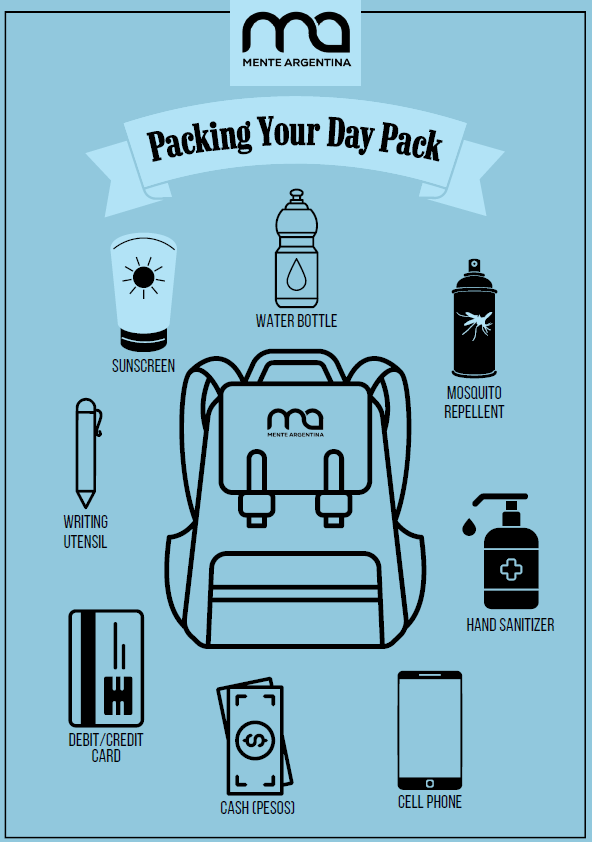
Every day on our program promises new adventures and experiences. To make the most of each outing and stay comfortable, it’s important to come prepared. The following checklist outlines the essential items you should pack in your day pack before you set off. From protection against the sun to staying hydrated, these selected items will help ensure your day is as smooth and enjoyable as possible. Keep this list handy, and get ready to explore Argentina with confidence!
MONEY WISE: SHOULD I TAKE CASH TO ARGENTINA? CREDIT OR DEBIT CARDS? TRAVELER'S CHECKS?
Below you will find updated money-related recommendations for all international students planning to study in Argentina for a limited time (1 Year or less).
- Notify your bank before your trip to enable international transactions and inquire about partnerships with local banks in Buenos Aires to save on ATM withdrawal fees.
- ATM withdrawals can incur fees from both the local and your home bank. Withdraw larger amounts less frequently to minimize these fees, and check your bank’s international policies.
- While limited locations accept US dollars, carrying Argentine pesos for daily expenses is recommended. Keep some US dollars in a safe place for emergencies.
- Travelers’ checks are not recommended due to their limited acceptance and inconvenience. Prefer debit cards for cash withdrawals and credit cards for larger transactions and online purchases. Verify international fees with your bank in advance.
- Credit and debit cards, including Visa, MasterCard, and American Express, are broadly accepted. Confirm with your bank regarding any international transaction fees or restrictions.
- Plan your budget realistically. Argentina can be cost-effective, but unexpected expenses can accumulate. For budgeting assistance, contact a Mente Argentina Program Advisor.
- For accessible cash without direct ATM use, set up accounts with Xoom and Western Union before arrival. This enables you to transfer money from your home bank account to various pickup locations in Buenos Aires.
- Consider using a budget tracking app to monitor your spending and manage your finances more effectively. This can help you stay within your budget and save money for experiences you truly value.
- Establish an emergency fund. It’s wise to have a reserve of funds accessible in case of unforeseen circumstances or emergencies. This fund should be separate from your daily budget and savings.
USEFUL LINKS: MAKE SURE TO CHECK THESE LINKS PRIOR TO YOUR ARRIVAL TO ARGENTINA!
Here are some websites that will help you prepare for your studies in Buenos Aires, Argentina.
- Mente Argentina Blog - Get insights and tips on living and studying in Buenos Aires.
- Public Transportation Guide - Basic information on navigating the city.
- Time Out Buenos Aires - Discover events, shows, and cool places to explore.
- MercadoLibre - The "Amazon" of Buenos Aires for all your needs.
- Tourism Buenos Aires - Official tourism site with all you need to know about the city.
- Festivals and Events - Free cultural festivals and events in the city.
- Bus and Subway Guide - Official government site for bus and subway information.
- Clarín - A major Buenos Aires newspaper (in Spanish).
- La Nación - Another leading Buenos Aires newspaper (in Spanish).
- Página/12 - Buenos Aires newspaper with a focus on culture and politics (in Spanish).
- Buenos Aires Herald - Buenos Aires English language newspaper for expats and English speakers.
- Buenos Aires 123 - A comprehensive guide to services, entertainment, and living in Buenos Aires.
- Eventbrite Buenos Aires - Find local events ranging from professional meetups to cultural activities.
- PolyChat App - Learn Spanish from 16 languages with interactive exercises, immersive chat and custom vocabulary quizzes.
- Spanish Translator + - Comprehensive Spanish learning app with text, voice and image translation, plus 250,000+ word dictionary.
STUDY ARGENTINA GUIDE & STUDY ARGENTINA ARTICLES: IMMERSE YOURSELF NOW!
Mente Argentina has designed a comprehensive Study in Argentina guide for all international students looking to study abroad in Argentina. If you wuold like to check it out, please visit: Study in Argentina Guide.
We also have several interesting articles related to study in Argentina and to living in Buenos Aires in our blog. Make sure to check our most popular articles prior to your arrival!
LIVING EXPENSES IN BUENOS AIRES 2026
Wondering about living expenses in Buenos Aires? Here's an updated list of the price of popular items and services in the Argentine capital (all prices listed in US Dollars):
- Subway Fare: $0.80
- Bus Fare: $0.80
- Dance Club Entry: $6-$15
- A Drink at a Bar: $5-$10
- Steak Dinner at a Restaurant: $12-$30
- Taxi Ride (within city): $4-$15
- Movie Ticket: $8-$10
- Load of Laundry (self-service): $5
- A Good Bottle of Wine: $7-$14
- Coffee at a Café: $2-$6
- Fast Food Combo Meal: $5-$12
- Basic Lunchtime Menu (including a drink) in the Business District: $7-$14
- 1 kg of Apples: $1-$3
- 1 liter of Milk: $1-$2
- Loaf of Fresh White Bread: $1-$2
Explore the complete list of Living Expenses in Buenos Aires 2026 for a more detailed breakdown.
LIVING IN BUENOS AIRES, ARGENTINA
AIRPORT ARRIVAL - HOW WILL I FIND THE DRIVER FROM MENTE ARGENTINA?
Upon landing, one of our private drivers will meet you at the airport holding a sign with your name. After clearing customs, you'll find our driver easily as the Ezeiza Airport has only one exit hallway for international flights. The driver will take you to your accommodation, where a Program Coordinator will meet you with your welcome kit, maps, cell phone, and other essentials. They will also guide you on navigating the city and reaching your classes and answer any other questions you may have.
DO I NEED A PLUG ADAPTOR FOR ARGENTINA?
If you're coming from abroad, you will certainly need a plug adapter for your electronics. Argentine buildings use either a plug with two circular prongs (European style) or one with two flat blades in a V shape, with or without a third blade below (Australian style). Argentine electricity is 220 V, 50 Hz, which differs from the 110V used in many countries. Laptops usually have a voltage converter on the plug, but for larger electronics, you'll need a 220 to 110 volt transformer. You can either buy an adapter in your home country or purchase a relatively inexpensive one upon arrival in Argentina. For more information on which adapter you need, please check this link.
IS BUENOS AIRES SAFE?
Buenos Aires is a safe and modern city with well-developed medical, transportation, and legal systems. Like in any major urban area, we advise participants to be mindful of their safety and belongings. That said, violent crime rates in Buenos Aires are relatively low compared to other major world cities. All our program venues and host families are safe and security-aware. In addition, each participant receives a safety orientation upon arrival and additional safety information throughout their program. For more on safety in Buenos Aires, check out our health and safety information.
WHAT'S THE TRANSPORTATION LIKE IN BUENOS AIRES?
Buenos Aires offers a wide range of transportation options, complemented by pedestrian-friendly streets. Whether you're using public transport or exploring on foot, the city is accessible and welcoming.
- Subte (Subway): Connects major areas across Buenos Aires, with six lines running from early morning to late evening.
- Colectivos (Buses): An extensive network of over 150 bus lines that operate 24/7, covering the entire city and suburbs.
- Trenes (Trains): Facilitate commuter movement to and from suburban areas with key stations serving as hubs.
- Taxis and Ride-Sharing: Taxis are abundant, and services like Uber and Cabify offer convenient alternatives.
- Bicicletas (Bikes): Dedicated bike lanes and the EcoBici public bike-sharing program encourage cycling as a transport option.
- Ferries: Connect Buenos Aires to Uruguay, ideal for exploring beyond the city.
- Walking: Many program activities and places of interest are within walking distance, and the city's layout encourages walking as a pleasant way to explore.
Our accommodations are strategically located near subway stations and multiple bus lines, ensuring easy access to your program sites. From your very first day, your Mente Argentina Program Coordinator will provide you with guidance on the best transportation options to reach your destination. For more detailed information on transportation in Buenos Aires, you can refer to our blog post about navigating the city at Transportation in Buenos Aires.
CAN I HAVE MORE INFORMATION REGARDING THE GYM MEMBERSHIP?
Located in the Palermo neighborhood, our Health Club is a top-quality gym with new fitness equipment and a variety of classes to choose from. Your Mente Argentina Program Fee includes a gym membership for the duration of your program. It's a fantastic way to stay fit and interact with locals!
WHAT'S THE WEATHER LIKE IN BUENOS AIRES?
Buenos Aires experiences a temperate climate, with distinct seasons that offer a unique charm to the city at any time of the year. Located in the southern hemisphere, seasons are inverted compared to those in the northern hemisphere.
Summer (December to February): The city comes alive with warm and often hot weather, with temperatures ranging from 20°C to 35°C (68°F to 95°F). This is a perfect time for outdoor festivals, beach outings, and enjoying the vibrant street life. Light clothing and sun protection are essentials.
Autumn (March to May): With mild temperatures averaging between 15°C and 25°C (59°F to 77°F), autumn brings cooler evenings and crisp mornings. It's an ideal season for exploring parks and outdoor markets. Layered clothing is recommended as temperatures can fluctuate.
Winter (June to August): Cooler weather prevails, with average temperatures ranging from 5°C to 15°C (41°F to 59°F). Snow is rare in the city but can be found in nearby mountainous areas. Winters are generally mild, making it comfortable to enjoy cultural events and indoor attractions. Warm clothing and rain gear are advisable.
Spring (September to November): The city blooms in spring, with temperatures similar to autumn, ranging from 15°C to 25°C (59°F to 77°F). This season is marked by sunny days and occasional rain showers, perfect for visiting parks and enjoying the outdoors. Light jackets and comfortable shoes are recommended.
Given Buenos Aires' variable weather, packing layers is always a smart choice to accommodate the fluctuating temperatures. From hot summers to mild winters, the city's climate is generally agreeable, allowing for a variety of activities year-round. For detailed packing tips and seasonal advice, check out our blog on preparing for your visit to Buenos Aires.
HEALTH & SAFETY IN BUENOS AIRES, ARGENTINA
HEALTH & SAFETY OVERVIEW
The safety of our participants during their stay in Buenos Aires is a top priority of Mente Argentina. We are proactive about risk management in order to reduce the possibility of danger that may be presented to the participants; although we cannot, of course, eliminate all risk. Furthermore, student behavior is a critical component of a safe study abroad experience. Because of this we keep in close contact with the participants of the Mente Argentina program to offer help and guidance throughout their stay in Argentina. Our Mente Argentina staff works to prevent any kind of inconvenience with respect to health and safety for our participants.
Buenos Aires is a fairly safe city, but like any big city, it is important to take certain precautions and use common sense in order to enjoy the urban experience and take advantage of everything an international capital like Buenos Aires has to offer. The locals are remarkably friendly and eager to help out foreigners and travelers. However, participant should be aware that like all major cities, a certain level of crime may exist; the biggest threats to the traveler being petty theft and robbery.
As in any big city, locals and foreigners are recommended to always be aware of their surroundings, take precautions to place themselves in safe and comfortable environments, and avoid unnecessary risk.
On your arrival to your accommodation option, you will receive the Mente Argentina Welcome Guide with some practical suggestions as well as a short talk with recommendations from your Program Coordinator in Buenos Aires.
HEALTH INSURANCE IN BUENOS AIRES, ARGENTINA
Travel and Medical insurance is not included in Mente Argentina Programs. We strongly encourage students to get travel and health insurance. In the event that a participant does not have insurance, Mente Argentina can recommend some health insurance options.
We can assist participants in deciding which type of coverage best fits their needs, but the insurance company is not connected to Mente Argentina in any way, so we are not authorized to help participants with claims or disputes. Please note that Mente Argentina will not be responsible for any cost incurred by the student relating to medical illness, accidents or any other event that would result in the student early return.
Look into these options before your stay in Argentina:
- Check with your medical insurance at home. Many insurance companies will cover students while they are abroad. Also, be sure to check your provider’s reimbursement policies.
- Check with your credit card company. Many credit cards will provide travel and medical insurance for short periods of time.
- There are some short-term coverage plans here in Argentina that we can assist you in obtaining once you get here. A regular plan for a young and healthy individual costs between USD 80 – 115 per month. There are several companies that are the best and most trusted locally. We can put you in contact with these companies, but we suggest that you first look at these first two options:
MENTE ARGENTINA SAFETY RESOURCES IN BUENOS AIRES, ARGENTINA
Mente Argentina is very dedicated to the safety and health of our participants. Continually keeping security in mind, we are always looking for more ways to guarantee a safe and comfortable stay here in Buenos Aires for our participants, day or night!
Mente Argentina Safety Resources & Best Practices:
- On-site coordinators that have experience studying abroad, living in Buenos Aires, and speak both Spanish and English. These Mente Argentina staff members are available 24/7 to help students feel comfortable in Buenos Aires and make the most out of their stay. Upon the participant´s arrival, our coordinators will do a personalized check-in at the participants housing accommodation, giving them an orientation to the program and helping them get acquainted with the city.
- We provide students with a cellular phone during their stay in Argentina. For emergency reasons, parents can reach their child by calling or texting this number. Students will also have the numbers of our various coordinators programmed into their phones, so they will have several contacts persons from the very beginning of their arrival. Included in these numbers are emergency contacts as well as radio taxi numbers to help them find their way around the city in a safely and securely manner. An emergency contact card is also included in the Mente Argentina Welcome package.
- We provide students with a "pre-departure information" material and "travel check list" in order to help them get ready for their trip. Included in this information are safety tips, cultural information, banking and financial suggestions, and much more to prepare the participants for their travels.
- Upon arrival, students are provided with a personalized orientation and welcome guide that also includes maps of the city and public transportation, guides, discounts in stores, emergency phone numbers, important addresses, and many other suggestions about Buenos Aires and Argentina
- We provide weekly cultural activities as well as other trips, shows, or Mente Argentina events that allow the participants to explore different cultural settings of Buenos Aires in a friendly group setting. These cultural activities allow for participants to get to know each other and parts of the city, which promotes a learning, discovery, and understanding of Buenos Aires.
- We maintain a preferred network of trusted local hospitals, doctors and medical services. In case there is an emergency with one of our participants, one of our team members will accompany the participant to the hospital and be there to help with everything.
- We personally select all student housing placements based on the student’s preference. By selecting the student housing, we have personal contact with each student’s roommates in case of an emergency, and we ensure that all of our housing is safe and secure.
- We operate out travel and tourist activities with reputable providers.
- We regularly review emergency response and crisis management plans with local program coordinators and pass this information onto the participants.
HEALTH & SAFETY IN ARGENTINA: STUDENT TIPS
Participants Are Responsible For Their Safety
Keeping in mind our dedication to creating a healthy and safe abroad experience in Argentina, we recognize that both the health and safety of a participant is dependent on sensible student behavior. All students on our study abroad programs are legally adults and are ultimately responsible for their decision-making and their safety. We expect students to act in a safe and thoughtful manner; otherwise, we reserve the right to ask a student to leave the program.
Buenos Aires is a big city and travelers must take certain precautions to protect themselves and their belongings. In addition to our suggestions below, take a look at our blog post here for some more detailed safety advice.
Also, please find below are some of our preventative recommendations:
- Avoid carrying valuables out in the open, hanging on your neck or over your shoulder. Carry cameras, laptops, mp3 players, etc. in a secure bag. Avoid wearing flashy jewelry or valuable accessories that draw attention to you. Always remain alert for pickpockets, particularly in crowded areas such as plazas and on public transportation.
- Don’t flash money, wallets, etc. Keeping your wallet or money exposed is a dangerous idea because it draws attention to you and makes you a target for crime. Don’t keep your wallet on the table at restaurants, or simply sitting in your hands.
- Keep an eye on your belongings. Particularly in the Retiro bus station, luggage theft is an issue. Never leave your luggage alone. With that in mind, never offer to take or watch a stranger’s belongings.
- ATM withdrawals: We do not recommend withdrawing money from ATMs after dark. Always use ATMs located inside a bank and be aware of your surroundings before and after you leave the ATM, carefully checking that no one can see your important information or ATM code.
- Try not to walk alone in dark places, through parks, or neighborhoods you don’t know at night. Stay on well-lit and populated streets if possible. If you feel uncomfortable, try to find the nearest kiosk, restaurant, or populated area and wait there until that feeling has passed. Remember that there is safety in numbers, so when possible, travel with a group.
- Tell someone where you are going particularly if you are traveling alone. This way if someone needs to contact you or vice versa, there is someone aware of where you are and how they can reach you.
- Check maps before you go out. Looking lost or confused can make you look vulnerable. Especially at night, plan your route and how to get home, so that you know where you need to go later in the night.
- Be aware of your surroundings and strangers approaching you, offering bargains, or to be your guide. Remember that pickpockets tend to work in groups and may try to distract you.
- Speak Spanish as much as possible. This is not only good for your personal development and learning in Argentina, but it will help draw less attention to yourself as tourist. Avoid speaking loudly or obnoxiously, particularly in another foreign language.
- Taxis marked with the words “Radio Taxi” are associated with a legitimate taxi company that can account for each car and driver. Although some taxis may look like legitimate cabs, if they are not marked with the words “Radio Taxi”, we do not recommend taking them since there are fewer guarantees that they are licensed or legal.
- Avoid illegal drugs and activities. Every country has different policies and rules and it is better to avoid trouble with another nation’s legal system. Look up Argentine legal guidelines to familiarize yourself with the laws. Most importantly, remember when you engage in illegal behaivior you are not protected by the police. By involving yourself in illegal activities, you are putting yourself at extreme risk.
- The legal drinking age is 18 in Argentina. Remember that drinking responsibly is fundamental to protecting yourself and others. Know yourself and your limits.
- Locate your country’s embassy and consulates. Knowing where your embassy and consulates are, as well as how to contact them is important in case you need new or emergency legal documents of any kind.
- Read the news and stay updated on current events in the country and city you´re in. This way you not only improve your Spanish and learn about Argentine and Porteño culture, but you stay updated on safety and security issues. Mente Argentina recommends you look at the websites listed in our Useful Links section.
- Photocopy all important documents (passports, airplane tickets, health insurance card, driver's license, student ID, etc). Leave copies of these documents safely at home, so if something is lost or stolen, you still have access to backup information.
- Keep in contact with people back home. Not only will your friends and family appreciate it, but it is best that someone knows where you are to prevent them from worrying needlessly.
- Take the same precautions you would at home. Don’t give out your name or address, and don’t share program information with strangers.
- If you are feeling sick, don’t be afraid to go to the hospital or doctor´s office. In order to keep yourself safe, you need to keep yourself healthy. Contact the Mente Argentina program coordinators as soon as you feel ill, and we will set you up with the best options tailored to your personal health needs.
- Mente Argentina Staff will brief you on general safety guidelines when you check in. Ask them about safety precautions and locations that may be less safe at certain times of day. If you have questions regarding health or safety, do not hesitate to ask. Mente Staff are knowledgeable about Buenos Aires and can help you make the most of your experience here.
HEALTH & SAFETY IN ARGENTINA: TIPS FOR PARENTS
We encourage students and parents to have in-depth discussions about safety before and during the study abroad process. We also encourage parents and students to read the Health and Safety practices recommended by the Interassociational Advisory Committee on Safety and Responsibility in Study Abroad, a consortium made up of the leading organizations in overseas studies. We believe this information offers a helpful overview of the best practices for study abroad providers, students and parents in health and safety issues.
Other Mente Argentina Tips for Parents
It´s important that we have both you and your child´s contact information.
- Make sure your child has provided you with several contact methods, including the Mente Argentina Student Reception Offfice address and phone number, your participant’s home and cell phone numbers, and email address.
- Make sure your child has your contact information as well, including office, home, and cell phone numbers, email address, and the contact information for a neighbor, close relative and/or good friend who will be able to reach you in case of an emergency
- Providing Mente Argentina with your own contact information as well assures extra security measures are taken and that the Mente Argentina staff can reach you if necessary.
Communicating about health and safety assures that you and your child are on the same page
- Help your child obtain travel insurance, health insurance, and any other legal precautions before he/she leaves for Argentina
- Discuss safety and health precautions with your child before they leave for the country. This assures that both you and the participant are aware of potential risks and solutions while he/she is away
- Keep in touch with your child during his/her trip, particularly about any travel plans and activities that may be independent of the Mente Argentina Program. This way you are informed about your child´s whereabouts in case you need to contact them.
Be informed about your child activities
- Stay updated on the events in Buenos Aires. Keeping informed will help you know what is going on in the city, and will keep you in the know.
- Have copies of your child ’s important documents and flight itinerary in a safe and accessible place.
HEALTH & SAFETY IN ARGENTINA: EMERGENCY INFORMATION
If you have any emergency whatsoever (legal or medical), and if you are currently enrolled in a Mente Argentina Program, please contact us immediately at the telephone number that appears on the Emergency Contact Card that you received on your arrival to Buenos Aires or Contact us now
MENTE ARGENTINA EDUCATORS SECTION
INFORMATION FOR REPRESENTATIVES, FACULTY & ADVISORS
We have designed a special section for University Representatives, Faculty & Advisors around the world. If you would like to have access to this special section please contact us.
MENTE ARGENTINA FREQUENTLY ASKED QUESTIONS (FAQs)
Find below the most frequently questions we receive regarding our programs, the accommodation and booking process. You will also find the most typical questions regarding your arrival and your stay in Buenos Aires, Argentina.
If you have any questions regarding a specific program, or if you have a doubt or question about anything else, you can always get in contact with our program advisors here.
BOOKING INFORMATION
HOW DO I BOOK A PROGRAM?
As a first step, please go ahead and create your online account here. By creating your Online Account, you are taking the first step in your journey abroad with Mente Argentina.
By completing the first few steps of your application process, your place in the program will be officially saved:
- Enter your Contact Information
- Provide your Academic Information
- Enter your Emergency Contact Information
- Specify your Program Information
- Provide your Accommodation Information
- Complete the Registration Fee Payment
You are then welcome to upload your application documents as soon as you have them ready! You will still be able to make as many changes and updates as needed so no worries! :)
WHAT PROGRAMS DO YOU OFFER?
Explore Mente Argentina Programs in Buenos Aires 2026
Remember you can always combine multiple programs either at the same time or back to back.
Mente Argentina Spanish Programs
Live, Learn & Explore
Learn Spanish in Buenos Aires with Mente Argentina
At Mente Argentina, we offer two distinct options for learning Spanish, each offering exceptional instruction tailored to meet your specific needs and interests. Whichever option you choose, our experienced instructors and immersive approach will ensure you make significant progress in your Spanish language journey....
Mente Argentina Intensive Spanish Program
- Classes held at our private language institute, offering flexibility.
- Flexible starting date: classes start every week.
- Programs can be taken in weekly increments to accommodate your schedule.
- Offers various learning options including intensive group Spanish lessons (20 hours per week), regular group Spanish lessons (9 hours per week), Private Spanish Lessons and more.
- Designed for those focused on learning or improving their Spanish.
- Academic credit option available: participants can obtain an official university transcript at the end of the program.
University Spanish Program at Top Local Universities
- Courses taught at renowned universities in Argentina.
- Fixed starting date: classes begin on the first week of every month.
- Perfect for college-age students, recent high school graduates, and anyone looking to learn Spanish in a university environment.
- Excellent opportunity for earning academic credit and experiencing a university environment.
Enjoy a variety of benefits and services: All of our programs include a variety of benefits and services, including:
- Airport transfers
- Accommodation in student residences, shared apartments, homestays or Private Apartments.
- Cultural activities and excursions
- 1 to 1 support from our team of experienced local staff
By joining Mente Argentina, you're not only signing up for an immersive language learning experience, but also joining a vibrant community. You'll connect with participants from all over the world, ensuring you'll never feel alone during your stay.
Moreover, we offer a great level of personalization. You have the possibility to combine multiple programs at the same time, and we're open to customize this program as needed. We pride ourselves on our flexibility and ability to adapt to each participant's needs.
Explore our Spanish language programs today and take the next step towards mastering Spanish in the culturally rich context of Argentina!


Mente Argentina Short Programs
Live, Learn & Explore
Discover an Unforgettable Experience with Mente Argentina's Short Programs
Join a community of like-minded people from all over the world and learn new skills, engage in sports, or advance your knowledge according to your interests with our short programs (2 to 16 Weeks or longer!).
Our programs are specially designed for individuals who want to spend 15, 30 days or even up to a few months in Argentina. We offer a wide variety of programs, so you can find the perfect one for your interests and goals. Whether you want to learn about wines, Tango, photography, how to cook, code, or get an international teaching certificate, we have a program for you....
Why Choose Our Short Programs?
- High-quality education: Our courses are taught by the best professionals in Argentina and take place at the finest schools. You'll learn in a fun and interesting environment.
- Internationally diverse: You'll have the opportunity to meet new people from all over the world.
- All-inclusive packages: Experience it all with the convenience of our all-inclusive packages. Our programs cover everything you need, including tuition, accommodations, activities and excursions, as well as additional services and support.
Enjoy a variety of benefits and services: All of our programs include a variety of benefits and services, including:
- Airport transfers
- Accommodation in student residences, shared apartments, homestays or Private Apartments.
- Cultural activities and excursions
- 1 to 1 support from our team of experienced local staff
Moreover, we offer a great level of personalization. You have the possibility to combine multiple programs at the same time, and we're open to customize this program as needed. We pride ourselves on our flexibility and ability to adapt to each participant's needs.
Explore our Short Programs today and take the next step towards an unforgettable experience in Argentina!


Mente Argentina Internship & Volunteer
Live, Learn & Explore
Discover Internship and Volunteer Programs in Buenos Aires with Mente Argentina
Mente Argentina is a leading provider of international internship and volunteer programs in Buenos Aires. Whether you want to gain work experience in your field of study, give back to the community, or simply explore a new culture, we offer a wide variety of programs for you to find the perfect fit for your interests and goals....
Why Choose Mente Argentina's Internship and Volunteer Programs?
- High-quality experience: Our programs are designed to provide you with a high-quality experience that will help you achieve your goals while enjoying the best of Buenos Aires.
- Reputable partnerships: We partner with top-notch organizations and institutions to ensure you have the best opportunities available.
- Extensive support services: We offer a variety of support services to make your experience as smooth and enjoyable as possible.
- A unique network of international professionals and participants
- The opportunity to meet other participants from all over the world
- The convenience of having all of your travel details taken care of while giving you as much flexibility as you need
Enjoy a variety of benefits and services: All of our programs include a variety of benefits and services, including:
- Airport transfers
- Accommodation in student residences, shared apartments, homestays or Private Apartments.
- Cultural activities and excursions
- 1 to 1 support from our team of experienced local staff
Moreover, we offer a great level of personalization. You have the possibility to combine multiple programs at the same time, and we're open to customize this program as needed. We pride ourselves on our flexibility and ability to adapt to each participant's needs.
If you are interested in gaining valuable experience, making a difference in the world, or simply exploring a new culture, we encourage you to learn more about our internship and volunteer programs in Buenos Aires, Argentina!


Mente Argentina Study Abroad Programs
Live, Learn & Explore
Mente Argentina: Study Abroad in Buenos Aires
Mente Argentina is a leading provider of study abroad programs in Argentina. We offer a wide variety of programs for high school, university, and college students, all designed to help you gain academic credit, learn about Argentine culture, and make valuable connections.
Our programs are accredited by leading universities in Argentina and Latin America, so you can be confident that you will earn the credits you need to graduate. We also offer a variety of cultural activities and excursions, so you can immerse yourself in Argentine culture and experience the country firsthand....
Benefits of studying abroad with Mente Argentina
- Gain academic credit: Our programs are accredited by leading universities in Argentina and Latin America, so you can be confident that you will earn the credits you need to graduate.
- Learn about Argentine culture: Our programs offer you the opportunity to live and study in Argentina, where you can immerse yourself in the culture and experience the country firsthand.
- Make valuable connections: Our programs provide you with the opportunity to meet other students from all over the world and make lifelong friends.
Enjoy a variety of benefits and services: All of our programs include a variety of benefits and services, including:
- Airport transfers
- Accommodation in student residences, shared apartments, homestays or Private Apartments.
- Cultural activities and excursions
- 1 to 1 support from our team of experienced local staff
If you are interested in studying abroad in Buenos Aires, Argentina, our study abroad programs will be a great fit for you. We offer a variety of programs to fit your needs and interests, and we are committed to providing you with a positive and enriching experience.
Moreover, we offer a great level of personalization. You have the possibility to combine multiple programs at the same time, and we're open to customize this program as needed. We pride ourselves on our flexibility and ability to adapt to each student's needs.


Mente Argentina Graduate Programs
Live, Learn & Explore
Are You Considering Doing yours Master's Degree or Graduate Program in Argentina?
We provide everything you need to be successful and enjoy your time abroad. Pursuing your master's in Argentina creates countless opportunities for your future.
Mente Argentina offers several options to help you achieve your academic goals and seamlessly integrate into Argentine culture. We collaborate with the most important and recognized universities in Argentina and Latin America, ensuring the highest quality instruction and educational standards....
Our Programs Include Everything You Need
- Visa assistance (if needed)
- Assistance with selecting the right graduate degree
- Help with application documents and materials
- Guidance for a successful enrollment
- Activities and networking events
- Access to our team of experts
Enjoy a variety of benefits and services: All of our programs include a variety of benefits and services, including:
- Airport transfers
- Accommodation in student residences, shared apartments, homestays or Private Apartments.
- Cultural activities and excursions
- 1 to 1 support from our team of experienced local staff
Let Mente Argentina guide you on your journey to academic and personal growth!
Moreover, we offer a great level of personalization. You have the possibility to combine multiple programs at the same time, and we're open to customize this program as needed. We pride ourselves on our flexibility and ability to adapt to each participant's needs.
Explore our Graduate Programs today and take the next step towards your academic and personal success!
Mente Argentina Degrees & Specializations
Live, Learn & Explore
Explore our Degrees and Specializations Programs at Mente Argentina
Our programs are taught at some of the most prestigious universities in Latin America and Argentina, ensuring a high standard of education and internationally recognized degrees.
When you choose Mente Argentina, you can expect comprehensive support and valuable benefits, including visa assistance (if needed), accommodation, activities and networking events, access to our team of experts. Studying for your degree in Argentina will give you a competitive edge in the job market and open doors to exciting opportunities....
Advantages of studying for a degree or specialization with Mente Argentina:
- High-quality education: Our programs are taught by esteemed faculty at renowned universities, ensuring a top-notch education.
- Internationally recognized degrees: Our diplomas are recognized by the Argentine Ministry of Education, adding value to your education.
- Networking opportunities: Connect with students, professionals, and alumni from diverse backgrounds and build valuable relationships.
- Gateway to new opportunities: Your degree from Argentina can open doors to a wide range of exciting career prospects.
Enjoy a variety of benefits and services: All of our programs include a variety of benefits and services, including:
- Airport transfers
- Accommodation in student residences, shared apartments, homestays or Private Apartments.
- Cultural activities and excursions
- 1 to 1 support from our team of experienced local staff
If you're ready to pursue your degree or specialization in Argentina, choose Mente Argentina for an enriching and rewarding experience.
Moreover, we offer a great level of personalization. You have the possibility to combine multiple programs at the same time, and we're open to customize this program as needed. We pride ourselves on our flexibility and ability to adapt to each participant's needs.
Explore our Degrees and Specializations Programs today and take the first step towards your dream career!


Mente Argentina Online Programs
Discover Mente Argentina Online Programs
Our Online Programs are designed to offer flexibility, convenience, and affordability, providing you with a quality education without compromising your schedule or budget.
Here are some of the key benefits of our Online Programs:
- Flexibility: Learn at your own pace and on your own schedule, allowing you to balance your studies with other commitments.
- Convenience: Access your courses from anywhere in the world with an internet connection, eliminating the need for commuting or attending physical classes.
- Affordability: Our Online Programs are cost-effective compared to traditional brick-and-mortar programs, ensuring you receive a valuable education without breaking the bank.
If you're seeking a flexible, convenient, and affordable learning experience, Mente Argentina Online Programs are the perfect fit for you.
Explore our range of Online Programs today and embark on a journey of knowledge and growth!
IS THE PROGRAM OPEN FOR PARTICIPANTS FROM ALL OVER THE WORLD?
Yes, absolutely! Mente Argentina welcomes participants from all corners of the globe, and you do not need to be a current student in order to join us! We've been privileged to host +2500 participants ranging in age from 17 to 90, hailing from more than 30 countries and over 200 universities. Please note that participants of certain nationalities may need to obtain a visa to enter Argentina.
To gain a deeper understanding of our programs and the diverse range of participants we welcome, we encourage you to view our Video Testimonials. You can also explore our vibrant and engaging community by visiting our Instagram.
DO I HAVE TO BOOK MY FLIGHTS AS PART OF MY APPLICATION?
No. We will need only to receive your flights details prior to your arrival so that we can coordinate your private airport pick up and private airport drop off which is included in your program at no extra cost.
CAN I OR MY PARENTS CALL YOU IF WE HAVE QUESTIONS OR NEED SUPPORT?
Absolutely! We are here to help and are always available to discuss your program options. You or your parents can reach us at our U.S. phone number +1 (858)-867-4042, or our Argentine phone number +54 11 3968 7861. We're also able to arrange a video call Monday to Friday from 10am to 6pm Argentina Time, to provide any guidance or answer questions you may have.
If you prefer, you can also reach out to us through our Contact Us page and we will respond to you as soon as possible. Please feel free to call or contact us anytime, we're here to support you!
MENTE ARGENTINA PROGRAM DETAILS
WHAT SERVICES ARE INCLUDED IN THE MENTE ARGENTINA PROGRAMS?
Every Mente Argentina Program is designed to provide a comprehensive and enriching experience. Each program includes a wide array of benefits designed to make your stay in Argentina as comfortable and enjoyable as possible. Here's a detailed rundown of what you can expect:
-
 Exclusive Accommodation in the best areas of Buenos Aires: Palermo, Belgrano, Barrio Norte or Recoleta (all utilities and expenses included)
Enjoy a fully furnished apartment in one of the best neighborhoods in Buenos Aires, with all utilities and expenses included. You'll have access to a kitchen, a private bathroom, and comfortable living spaces where you can relax and study.
Exclusive Accommodation in the best areas of Buenos Aires: Palermo, Belgrano, Barrio Norte or Recoleta (all utilities and expenses included)
Enjoy a fully furnished apartment in one of the best neighborhoods in Buenos Aires, with all utilities and expenses included. You'll have access to a kitchen, a private bathroom, and comfortable living spaces where you can relax and study.
-
 Full access to Mente Argentina Tours & Activities
Discover the best that Buenos Aires has to offer with our extensive selection of cultural and recreational activities. You'll have the opportunity to explore the city with local guides and other students in your program.
Full access to Mente Argentina Tours & Activities
Discover the best that Buenos Aires has to offer with our extensive selection of cultural and recreational activities. You'll have the opportunity to explore the city with local guides and other students in your program.
-
 Full Tuition cost and all related materials
Full tuition cost and all realted and required materials are included in the program fee
Full Tuition cost and all related materials
Full tuition cost and all realted and required materials are included in the program fee
-
 Private Airport Pick up
We'll make sure you arrive safely and comfortably in Buenos Aires with our private airport pick-up service. A Mente Argentina representative will meet you at the airport and take you directly to your accommodation.
Private Airport Pick up
We'll make sure you arrive safely and comfortably in Buenos Aires with our private airport pick-up service. A Mente Argentina representative will meet you at the airport and take you directly to your accommodation.
-
 Private Airport Drop off
We'll also make sure you have a stress-free departure from Buenos Aires with our private airport drop-off service. A Mente Argentina representative will take you directly to the airport and assist you with check-in and security procedures.
Private Airport Drop off
We'll also make sure you have a stress-free departure from Buenos Aires with our private airport drop-off service. A Mente Argentina representative will take you directly to the airport and assist you with check-in and security procedures.
-
 Welcome Orientation
Get to know the city and your fellow program participants with our welcome orientation session. You'll receive important information about your program and have the opportunity to ask questions and meet other students.
Welcome Orientation
Get to know the city and your fellow program participants with our welcome orientation session. You'll receive important information about your program and have the opportunity to ask questions and meet other students.
-
 Mente Argentina Welcome Kit (calling card, insider's city guide, maps, and more)
We want you to feel at home in Buenos Aires, which is why we provide all our program participants with a welcome kit that includes a local SIM card, insider's city guide, maps, and more.
Mente Argentina Welcome Kit (calling card, insider's city guide, maps, and more)
We want you to feel at home in Buenos Aires, which is why we provide all our program participants with a welcome kit that includes a local SIM card, insider's city guide, maps, and more.
-
 Health Club Membership: Free Gym membership included
Stay active and healthy during your stay in Buenos Aires with our free gym membership. You'll have access to a variety of fitness equipment and classes to keep you motivated.
Health Club Membership: Free Gym membership included
Stay active and healthy during your stay in Buenos Aires with our free gym membership. You'll have access to a variety of fitness equipment and classes to keep you motivated.
-
 Local SIM Card & Borrowed Cell Phone
Stay connected with friends and family back home and within Argentina with a free local cellular phone provided by Mente Argentina.
Local SIM Card & Borrowed Cell Phone
Stay connected with friends and family back home and within Argentina with a free local cellular phone provided by Mente Argentina.
-
 Mente Argentina ISIC Global Discount Card
Take advantage of exclusive discounts and offers with the Mente Argentina ISIC Global Discount Card, which is recognized in over 130 countries.
Mente Argentina ISIC Global Discount Card
Take advantage of exclusive discounts and offers with the Mente Argentina ISIC Global Discount Card, which is recognized in over 130 countries.
-
 Tango Lessons
Learn the famous Argentine tango and experience the city's vibrant music and dance scene with our tango lessons.
Tango Lessons
Learn the famous Argentine tango and experience the city's vibrant music and dance scene with our tango lessons.
-
 Conversation Exchange Partner
Improve your Spanish skills and make new friends by participating in our conversation exchange program. You'll have the opportunity to practice your language skills with a local Argentine student.
Conversation Exchange Partner
Improve your Spanish skills and make new friends by participating in our conversation exchange program. You'll have the opportunity to practice your language skills with a local Argentine student.
-
 Official Transcripts & Certificates
At the end of your program, you will receive an official Mente Argentina Certificate or University Transcript depeending on your chosen program at no extra cost.
Official Transcripts & Certificates
At the end of your program, you will receive an official Mente Argentina Certificate or University Transcript depeending on your chosen program at no extra cost.
-
 Mente Argentina On-site assistance & Support Services 24/7
We're here to support you throughout your program with on-site assistance and support services available 24/7. Whether you need help with your accommodation, program activities, or personal matters, we're here to help.
Mente Argentina On-site assistance & Support Services 24/7
We're here to support you throughout your program with on-site assistance and support services available 24/7. Whether you need help with your accommodation, program activities, or personal matters, we're here to help.
These are just some of the highlights. For a more detailed view of what our programs offer, we recommend visiting our Benefits page and reviewing your specific program brochure.
WHAT COSTS ARE NOT COVERED BY THE PROGRAM FEE?
While our programs cover a multitude of services, there are certain expenses that are not included and will need to be covered by the participant. These include:
-
 Flights to/from Argentina
Please note that airfare to and from Argentina is not included in the program fee and should be arranged separately.
Flights to/from Argentina
Please note that airfare to and from Argentina is not included in the program fee and should be arranged separately.
-
 Additional optional trips and travels during the program
Any additional trips or travel beyond the program itinerary will be at the participant's expense.
Additional optional trips and travels during the program
Any additional trips or travel beyond the program itinerary will be at the participant's expense.
-
 Personal expenses outside the Mente activities (e.g. food, transportation, free time activities, clothes)
Participants are responsible for their personal expenses during free time, including meals, transportation, activities, and personal items.
Personal expenses outside the Mente activities (e.g. food, transportation, free time activities, clothes)
Participants are responsible for their personal expenses during free time, including meals, transportation, activities, and personal items.
-
.png) Expenses for residences and visas (if required)
Costs associated with accommodations and visa requirements, if applicable, are not covered by the program fee.
Expenses for residences and visas (if required)
Costs associated with accommodations and visa requirements, if applicable, are not covered by the program fee.
-
 Health and travel insurance
Participants are responsible for obtaining health and travel insurance coverage for the duration of the program.
Health and travel insurance
Participants are responsible for obtaining health and travel insurance coverage for the duration of the program.
For tips and recommendations, please make sure to read our Travel Planning and Health & Safety sections in our Helpful Resources Section.
WHAT TYPE OF PHONE WILL PARTICIPANTS RECEIVE UPON ARRIVAL?
Having a cell phone is an essential tool for staying safe and communicating while in Buenos Aires. At Mente Argentina, we provide options to meet your communication needs, all with the help of your personalized assigned program coordinator in Buenos Aires.
Option 1: Local SIM Card
Upon arrival, participants have the option to receive a local SIM card with an initial credit. This allows you to have a local phone number from day one, making it easy to communicate with new friends, program coordinators, and emergency services. You can easily add credit to your SIM card at various locations throughout the city.
Option 2: Borrowed Cell Phone
For those who prefer not to use their own phone or obtain a local SIM card, we offer the option to borrow a cell phone from Mente Argentina. The borrowed phone is preprogrammed with important contact information, emergency details, and radio taxi numbers. Please note that for the borrowed phone option, we require a USD 250 security deposit, which will be refunded upon the return of the phone at the end of the program.
We encourage participants to share their Argentine cell phone number with parents, guardians, or loved ones for emergency purposes. Having a cell phone ensures that you can stay connected and have peace of mind throughout your time in Buenos Aires.
WHICH TOURS AND ACTIVITIES ARE INCLUDED IN THE PROGRAM FEE?
Our cultural activities, tours, and excursions are a key aspect that sets Mente Argentina Programs apart. We understand that the best way to learn about a culture is to experience it firsthand. That's why we offer a variety of activities that allow you to immerse yourself in Argentine culture, including:
- City tours of Buenos Aires, including the Recoleta Cemetery, the San Telmo neighborhood, and the Palermo Soho district.
- Visits to museums, such as the Museo Nacional de Bellas Artes (National Museum of Fine Arts) and the MALBA (Museo de Arte Latinoamericano de Buenos Aires).
- Lunches and dinners at traditional Argentine restaurants, where you can try the local specialties, such as asado (barbecue), empanadas (stuffed pastries), and dulce de leche (a caramel-like spread).
- Outings to theaters, tango shows, and other cultural events.
By participating in our diverse and enriching activities, you'll not only gain a unique perspective of Buenos Aires but also have the opportunity to meet fellow Mente Argentina participants, fellow travelers, and locals who share your passion for exploration.
Learn more about our Tours & Activities in Buenos Aires.
CAN I ENROLL IN MULTIPLE OR BACK-TO-BACK PROGRAMS?
Yes, you certainly can! In fact, you can typically enroll in up to 3 programs simultaneously. Such combined programs are considered as program add-ons and are heavily discounted compared to regular programs. If you're interested, please contact us to get a personalized quote for the specific programs you have in mind.
Back to Back Programs
If you are interested in enrolling in programs that take place one after another, we also offer a 15% to 25% discount on the subsequent programs. For more details and to request a quote, feel free to contact us.
WHO WILL BE MY CONTACT PERSON AND PROVIDE ON-SITE SUPPORT?
At Mente Argentina, we pride ourselves on offering friendly, reliable, and responsive on-site support with a personal touch. As a participant, you'll be assigned both a Program Advisor and a Program Coordinator.
Program Advisor
Your Program Advisor assists with pre-departure planning and other arrangements associated with your chosen program.
Program Coordinator
Your Program Coordinator is your go-to person for day-to-day program operations in Buenos Aires. They'll help you settle into your apartment, navigate the city, arrange social activities, and provide general support throughout your program. They'll also communicate logistics and accommodation details.
Our main goal is to ensure you can enjoy new experiences, visit new places, meet new people, and learn new things without dealing with frustrating problems or complex documentation. Whether you have questions about booking a ticket, phrasing something in Spanish, or finding fun weekend activities, don't hesitate to contact us! We're here to help.
We also assist with:
- Facilitating your transition into Argentine culture
- Providing assistance with any difficulties or questions that arise
- Acting as a liaison between you and the host institution, assisting with on-site course registration and other academic issues
- Monitoring your program progress
- Organizing a range of social and cultural activities
- Providing a local perspective on additional travel and immersion opportunities in Argentina
- Taking an interest in your personal well-being
OUR ON-SITE SUPPORT INCLUDES
On-site Assigned Program Coordinator
Prior to your arrival, you will be assigned an exclusive Mente Argentina Program Coordinator who lives in Buenos Aires year-round. This coordinator will assist you throughout your program duration with your unique needs and questions.
On-Site Mente Argentina Student Reception Office
Our Student Reception Office is open every business day. We welcome students to stop by with any questions or concerns for our program coordinators, who are always available and happy to assist.
On-Site Management Team
Our entire Management Team is located on-site as a local organization, enabling us to promptly resolve any issues or problems that can be challenging to handle on your own.
WHERE DO PARTICIPANTS ORIGINATE FROM AND WHAT IS THEIR AGE RANGE?
Most participants hail from the US, Canada, and Europe, with a smaller percentage coming from Asia, Africa, and the Middle East. The typical age range for most participants in our college/university programs is between 18 and 30 years old. However, we welcome students of all ages and encourage gender diversity in our programs.
For our short programs such as Tango, Cooking, Wine, Intensive Spanish, and Photography, we have a wider age range. These programs attract individuals who are passionate about learning and experiencing new things at any stage of life. Participants in these programs typically range from 30 to over 60 years old.
Regardless of your age, if you feel like exploring Buenos Aires, improving yourself, and meeting other participants from around the world, feel free to join us! We have programs designed to suit individuals of all ages and backgrounds. Come and be a part of the Mente Argentina experience!
DOES MENTE ARGENTINA OFFER SCHOLARSHIPS?
We understand that scholarships can be crucial for many students to study abroad. Therefore, Mente Argentina offers various scholarships annually for our programs in Buenos Aires. These scholarships are designed to assist motivated students who wish to study abroad but may need financial aid to cover the costs of travel and program fees. More details about the Mente Argentina Scholarship Program can be found under Financial Aid
ACCOMMODATION DETAILS
WHAT KIND OF ACCOMODATION DO YOU OFFER?
Mente offers housing in student residence (shared rooms), shared apartments (individual rooms), home stays (individual rooms) and private apartments. What accommodation you choose is up to your personal preference. While student residences and shared apartments are a great way to meet other people and socialise, private apartments offer the most privacy and home stays are usually the best way to train your Spanish. You can learn more about our Housing options here.
WHAT KIND OF ACCOMODATION SHOULD I CHOOSE?
SHARED APARTMENTS
If you would like to have your own private bedroom and also meet participants from all over the world, our Shared Apartments are probably the best option. The majority of our participants choose the shared apartments because they provide the perfect mix of privacy (private room) and meeting other international participants.
HOMESTAYS
Having a home base, the friendly daily interactions, and Spanish practice are all great reasons why participants choose the Homestay option. The homestay option offers you a private room with your own private bathroom in a personal family environment. You will not have specific responsibilities when you live with a family such as particular duties or chores, but you will be expected to respect all of the rules and guidelines that other household members respect. The families we work with a generally very liberal, open minded, and flexible, so that they have an accurate understanding about a young person’s lifestyle when they visit Buenos Aires. Although you will be expected to follow basic house rules, you will have the opportunity to talk to the family about your personal habits and preferred schedule.
PRIVATE APARTMENTS
A Private Apartment is another option that tends to be favored by working professionals with more experience and by participants over 30 years old. Living in accordance with the rules of a family, or sharing the apartment with somebody else can sometimes be limiting for participants accustomed to living independently, so this is something to keep in mind when choosing an accommodation option.
STUDENT RESIDENCE
The student residence resembles a university dorm, with 2-4 students in every room. In terms of who you will be living with, our student residences house a variety of students, including Argentines, students from other South American countries, other international students currently studying in BA, and Mente Argentina students. If you are on a budget, and you dont mind sharing your room with other participants, this would probably be the right choice. All our accommodation options are located in Belgrano, Palermo, Recoleta, and Barrio Norte, the best areas of Buenos Aires near bars, restaurants, nightlife, and public transportation. They come fully furnished and equipped with internet, a cleaning service, and everything else you’ll need.
IN WHICH AREAS AREAS THE ACCOMMODATIONS LOCATED?
We believe that accommodations are one of the most important elements of our programs and are a key factor in ensuring that you enjoy your time in Buenos Aires. All of our accommodation options are located in the most exclusive neighborhoods in Buenos Aires such as Palermo, Belgrano, Barrio Norte or Recoleta, close to public transportation, so that you can safely and easily navigate the city during your stay. Free time? Enjoy our post about Buenos Aires Neighborhoods
WHEN DO I GET THE ADDRESS OF MY ACCOMMODATION?
Your Program Coordinator in Buenos Aires will be sending you a special pre departure information packet 10 days to 2 weeks before you are set to arrive. This email attachment will contain your specific apartment location, tips for getting around the city, pick up confirmation details, and some other important information about the program. You can include your housing preferences in your application and you can be sure that all our accommodation is located in good and safe areas.
WHEN CAN I MOVE INTO MY ACCOMMODATION?
As early as you want! Mente Argentina Programs are measured in exact weeks from Monday to Sunday. Please keep in mind that your program officially begins on Monday and ends on Sunday. We give every Mente Argentina participant an extra 2 days/nights to get settled in and prepare before their program starts (arriving the Saturday before the program start date at no extra cost). After that you are more than welcome to book extra time in your accommodation keeping in mind additional fees that would depend on your chosen type of accommodation.
IS THERE A MEAL PLAN INCLUDED IN THE PROGRAM?
Meal plans are available for participants staying in the student residences and homestay accommodations. The additional cost for the meal plan would be USD 300 every 4 Weeks and that includes both breakfast and dinner Monday through Friday. If you choose our Shared or Private Apartments you will have access to a fully equipped kitchen to cook your own meals. The apartment kitchen includes an oven, stove, and microwave. It comes fully stocked with all utensils, pots, pans, etc. so that you will have anything you need to cook. Mente is also accustomed to replacing or purchasing household goods that students request. In addition, all of our apartments are located close to many supermarkets and restaurants, so buying food or going out to eat is always easy and convenient.
WHO WILL BE MY ROOMMATES?
Who you’ll be living with depends on which type of accommodation you choose. Our accommodation houses a variety of students, including Argentines, students from other South American countries, other international students currently studying in BA, and Mente Argentina students.Mente places roommates together based on age, program type, interests and a host of other factors that will ensure that roommates get along and enjoy each other’s company.
ARE PILLOWS, SHEETS, AND TOWELS PROVIDED?
Yes. Pillows, sheets, and towels are provided, although, depending mostly on the program duration, some participants prefer to bring their own. As for the items in the apartments, they come fully furnished with all major electronics, appliances, and utensils, including everything you need to cook. They come with linens, a weekly maid service, and will be equipped with high speed internet. We recommend that you bring personal you might bring on any trip such as clothes, books, toiletries, etc. You can also find these Packing Tips on our website here under the tab TRAVEL PLANNING and at our blog.
WHAT SHOULD I PACK OR BRING TO THE APARTMENTS?
We recommend that you bring personal belongings that you might bring on any trip such as clothes, books, toiletries, etc. You don’t need to bring anything particular for the apartment. Pillows, sheets, and towels are provided from Mente. The apartments are also fully furnished with all major electronics, appliances, and utensils, including everything you need to cook. You can also find these Packing Tips on our website here under the tab TRAVEL PLANNING and at our blog.