
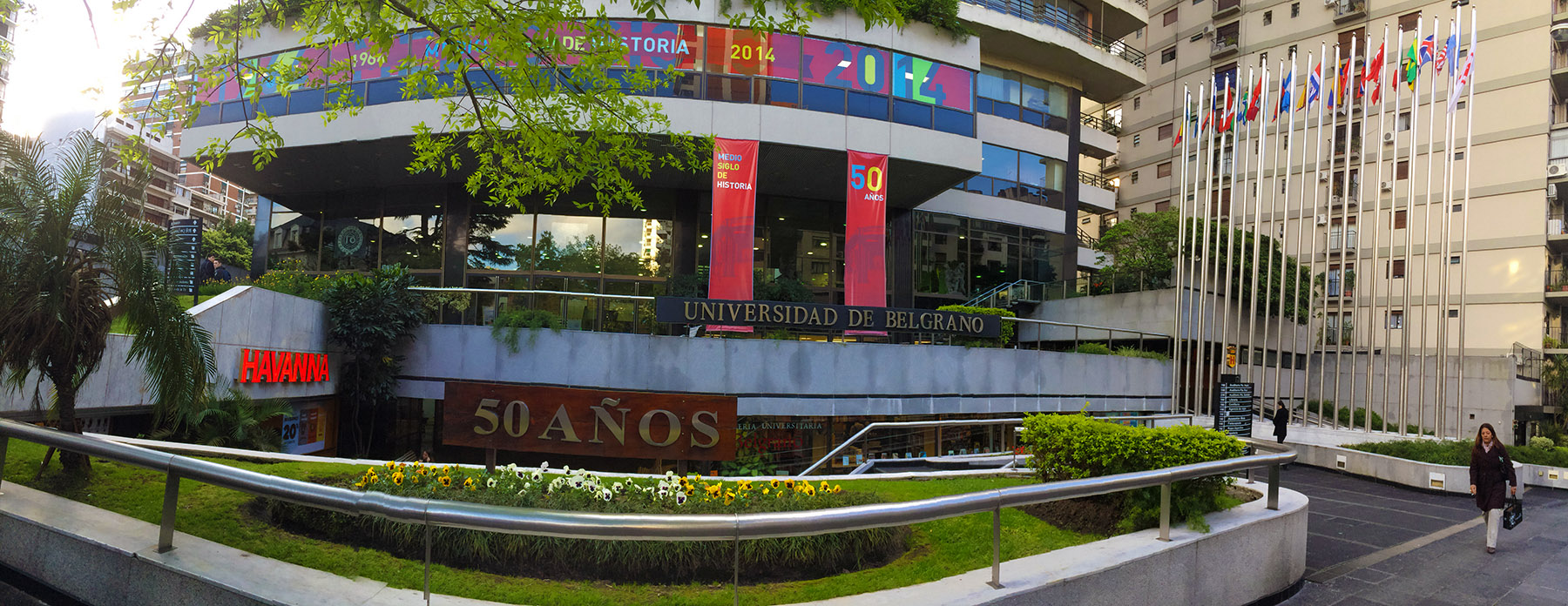
Course Offerings for the 2026-2027 Academic Semester Program at Universidad de Belgrano
The following is a list of courses offered through the Mente Argentina Academic Semester Program at Universidad de Belgrano 2026-2027.
Mente Argentina Academic Semester Program at University of Belgrano offers courses for students with all spanish levels.
Depending on your current Spanish Level you can choose to take courses from the following programs:
- Latin American Studies in English (Semester Courses taught in English + Spanish Language Courses)
- Latin American Studies in Spanish (Semester Courses taught in Spanish for international students + Spanish Language Courses)
- Integrated Studies (Semester Courses taught in English and Spanish + Courses with Argentine Students + Spanish Language Courses)
- Intensive Spanish Language-Semester (Intensive Spanish Language Courses)
You may choose to take courses directly from one of the programs or mix and match courses from various programs!
Description
This survey course studies the formation of the relationship between the U. S. and Latin America since the early days of the Wars of Independence. The period of continental state formation, the subsequent U. S. southward expansion by the turn of the century, and the transformations that occurred as a consequence of U.S. position as a world power, including the World Wars, the Cold War and its aftermath, and the current post-Cold War transition will be analyzed also. While the course will implement a comprehensive historical approach, the focus is placed on the analysis of specific moments and crises. Even when the Eighteenth and Nineteenth Centuries are the grounds to understand the process of policy formation, the bulk of the course concentrates on the diplomatic performance in the Twentieth Century to the present.
We will not only address the analysis of the major continental actors that shaped the core of the inter-American relations but also to less known actors that have impacted relations as well.
DONWLOAD THE COURSE SYLLABUS BELOW FOR DETAILED INFORMATION
Description
Once one of the richest and fastest growing economies in the world, Argentina is now entrenched in the rankings of the less developed countries. Nevertheless, in the last decade it has grown at a fast pace, one that was hard to predict in the days of the 2001-2002 crisis. That a country that was viewed as a pariah, effectively shut out of the international financial markets, could recover from its worst crisis, is the topic of recent academic and political discussions. The course will provide a truly comprehensive perspective that will enable the students to analyze and understand the process experienced by the Argentine economy from the late 19th Century until the present days, focusing on the processes that led to the economic crisis at the turn of this century and the measures implemented to overcome it. In the current world crisis scenario, Argentina can thus serve as a case study of sorts.
DONWLOAD THE COURSE SYLLABUS BELOW FOR DETAILED INFORMATION
Description
This course focuses on national identity in Argentina, Bolivia, Brazil, Chile, Cuba, Mexico and Venezuela resulting from political and social change. Students are encouraged to understand the political systems and parties in each country from a historical perspective. Present-day social actors and protest movements are similarly contextualized within ongoing struggles between the state and various forces in society. The course also considers collective memories of the repression inflicted by successive military dictatorships in some of these countries and the role of citizenship and institutions in contemporary democracies.
DONWLOAD THE COURSE SYLLABUS BELOW FOR DETAILED INFORMATION
Description
The course deals with the international economic relations between the Latin American countries and other geo-economic spaces, i.e.: European Union (EU), NAFTA and ASEAN. After a brief analysis of the evolution from the “three worlds of economics” to present-day “global economy”, the course deals with: economic cooperation, trade issues, business development and socio-political aspects. Although all the regions will be taken into account, a special stress will be put not only in the cases of the economic relations with the E.U., NAFTA and ASEAN, but also within the Latin American Region and in the role of international organizations and multinational corporations. The prospects of BRIC (Brazil, Russia, India and China) as economic leaders of the world will also be addressed. The analysis will be complemented with selected case studies on: Knowledge and Information, Technology Transfer and the Role of Multinational Companies. Finally, we will discuss: the present Global Crisis; the Role of G-20; and an Agenda for the 21st century.
DONWLOAD THE COURSE SYLLABUS BELOW FOR DETAILED INFORMATION
Description
Since its discovery until the present, Latin America has been imagined and conceived as the “New Continent”, a place for utopia, but also as a space of uneven modernity and extreme forms of violence. The course explores distinctive cultural aspects of Latin America by looking at the ways it has been represented in readings spanning from the diaries written by Christopher Columbus to the texts of the Cuban Revolution, the iconography of Peronismo, or the recent debates on Neoliberalism, Globalization and Populism. Drawing on essays, but also on short-stories, paintings, photographs, and films, the course addresses a set of questions that lie at the heart of how one thinks about Latin America. What is expected from “Latin America”? What were the different “ideas” that Latin America embodied? What are the forms of “Latin American” culture? How are the different “cultures” connected? The purpose of the course is threefold: to introduce students to problems central to Latin America, to familiarize students with a variety of non-fictional writings in Spanish, such as essay, chronicle, journalism and documentary films, and to sharpen student’s skills as analytical readers..
DONWLOAD THE COURSE SYLLABUS BELOW FOR DETAILED INFORMATION
Description
The cultural and human responses to the violence of genocide politics in the Holocaust will serve as an excellent start point to analyze political repression in Latin America (focus on Guatemala, Uruguay, Argentina and Chile). Central to the theoretical and critical corpus of the course, is the multidisciplinary work of scholars (e.g. Soshana Feldman, Cathy Caruth, Dominick La Capra, Astrid Erll, Jean Amery, Giorgio Agamben). This course discusses not only the impact of trauma, the legacy of memory and the role of the national states during dictatorships in these countries, but also how to make these experiences productive to reconstruct selves and societies. The corpus includes literature, testimonies, documentary and feature film, art, oral history, journalism, poem and popular music by such authors as French-Jewish Claude Lanzmann, Chilean film director Patricio Guzmán, Guatemalan writer Rigoberta Menchú, Uruguayan poets Mario Benedetti and Mauricio Rosencof and songs by Argentine composers and interpreters Luis Alberto Spinetta and Charly García.
DONWLOAD THE COURSE SYLLABUS BELOW FOR DETAILED INFORMATION
Description
Description
PLEASE CONTACT US IF YOU NEED THE COMPLETE SYLLABUS FOR THIS COURSE
Description
PLEASE CONTACT US IF YOU NEED THE COMPLETE SYLLABUS FOR THIS COURSE
Description
PLEASE CONTACT US IF YOU NEED THE COMPLETE SYLLABUS FOR THIS COURSE